
Episode 36: How to Up Your Instagram Game with Growth & Engagement
Instagram has so much value for both creators and consumers. It has the power to launch careers, and can literally make or break the success of a company or a campaign. Whether you’re a hobbyist, small biz owner, or aspiring social media manager, there’s a ton to gain from the platform, so today we’re diving into all things growth and engagement for Instagram with Laura Bitoiu, founder of B Squared Social.
If you want to learn how to build an engaged social community, which IG tools you should use to move the needle, how the algorithm really works, why reels have the best ROI, and what tools to use to streamline your social strategy, this episode is for you.

Instagram has so much value for both creators and consumers. It has the power to launch careers, and can literally make or break the success of a company or a campaign. Whether you’re a hobbyist, small biz owner, or aspiring social media manager, there’s a ton to gain from the platform, so today we’re diving into all things growth and engagement for Instagram with Laura Bitoiu, founder of B Squared Social.
If you want to learn how to build an engaged social community, which IG tools you should use to move the needle, how the algorithm really works, why reels have the best ROI, and what tools to use to streamline your social strategy, this episode is for you.
Laura is the founder of B Squared Social, a boutique social media marketing agency based in Vancouver, BC that offers social media marketing solutions for premium brands and service-based professionals. She offers coaching, consulting, online courses, and social media management services, and she basically quadrupled her own following by doubling down on IG Reels this past year, so she knows a thing or two about rapid growth.
Tune in to hear more about:
Why niching down your account is best practice
How Reels offer the most ROI of any content type—and how to crush your reels
Which IG features you should be using to maximize engagement
The secret sauce to going Live, and why it’s worth it
How the algorithm really works, and how to make it work for you
The best ways to show up in your IG Stories and how they actually convert
The value of developing a voice or persona for your social brand
Three things small businesses should do to create a successful IG presence
What tools or software to use to map out your content
How to overcome overthinking and anxiety on social
Strategies for breaking out of a creative rut and brainstorming new content
How to set healthy boundaries with social media
We hope this episode helps you make the most out of Instagram so you can grow online like a boss!
Follow Laura:
Mentioned in this episode:
If you have a topic you’d like us to cover or a guest you want us to interview, comment or DM us on Instagram:
Related Episodes:


Episode 07: How To Pivot Your Small Business and Thrive Online During Coronavirus
With the hard-hitting effects of coronavirus, it’s a tough time for entrepreneurs and small businesses right now, so we’re diving into all the ways you can pivot your business to digital, because your business deserves to make it.
Today, we’re tapping into our favourite moment from Friends so we can all learn to PIVOTTTT! PIVOTTTT.
With the hard-hitting effects of coronavirus, it’s a tough time for entrepreneurs and small businesses right now, so we’re diving into all the ways you can pivot your business to digital, because your business deserves to make it.
How your business responds to this crisis will play a huge part in its future, and we want to help, so we talked to digital guru, business consultant and productivity strategist, Alyssa Coleman. She’s the founder of The Productive Entrepreneur, a strategic coaching program, she hosts events for companies like Lululemon, and she runs epic career-coaching retreats around the world. Listen to the episode or scroll down to see all of the tips, tricks and strategies that Alyssa shared with us to help keep your small business going.
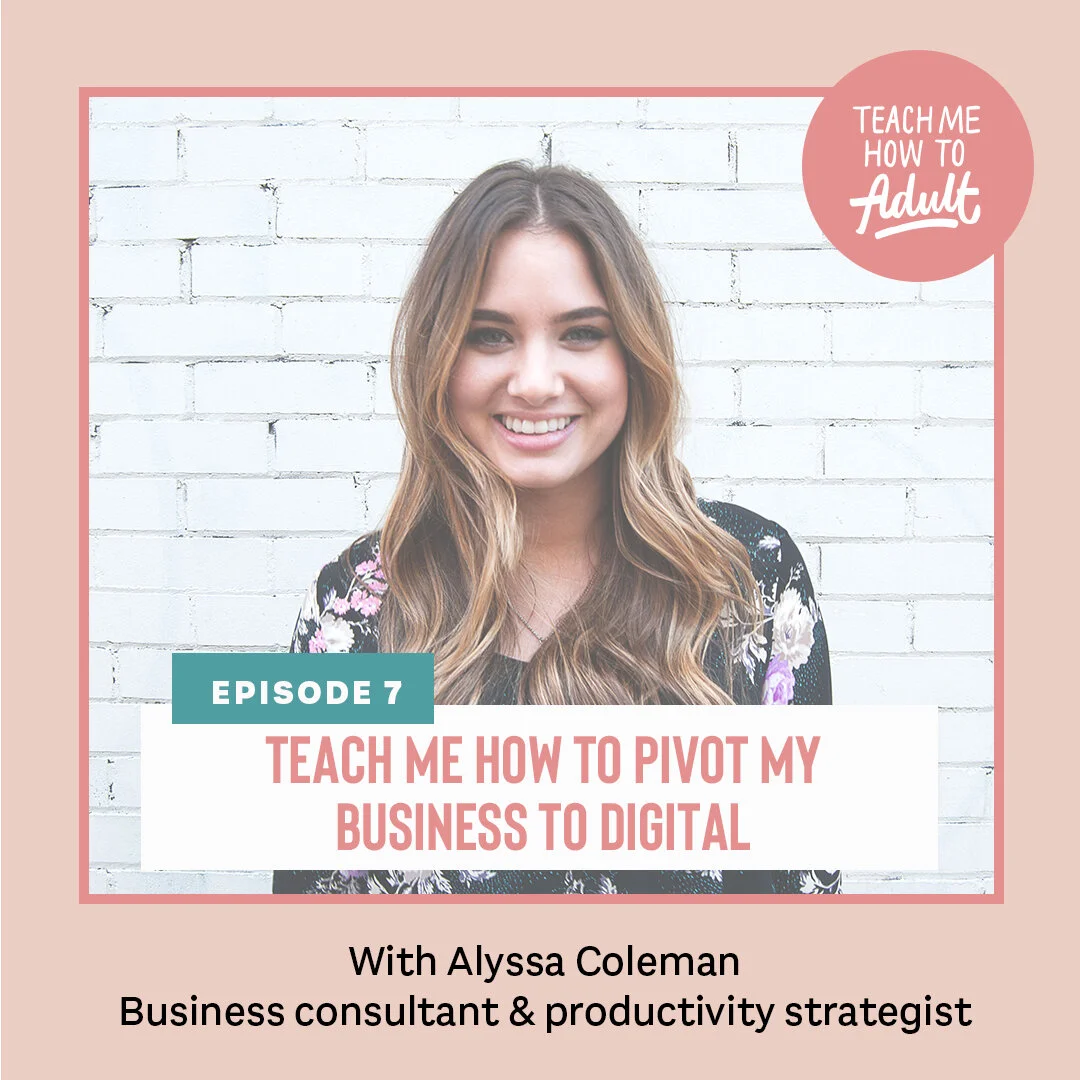
We were SO inspired by our chat with Alyssa and have already started seeing results from her advice. She has tons more strategies that helped us, and you can access all those processes, templates, workbooks, video training and tools in
her signature program Your Most Profitable Quarter Yet.
BONUS: She’s giving Teach Me How To Adult listeners a special discount of $250.00 off the program when you sign up with THIS LINK and use the code “FRIENDPRICE”!
Things may look a lot different for you for the next while, but that doesn’t mean you need to give up on our business altogether. Whether you’re a big company like Dyson, which is producing ventilators to help fight Covid-19, or a local distillery that’s now exclusively making hand sanitizer (shoutout to Mill St. Brewery), there are lots of ways to pivot and make an impact.
And if you’re just trying to stay afloat and make ends meet right now, the best place to start is online. Spend this time rethinking your products or services to meet current demands, and consider how you can help out and get active in your online community:
Offer encouragement and support to your audience
Give them a behind the scenes look at your brand on social
Remind them that you’re still in business and that you still have services, products or content to offer
Experiment! Get super active on social media and forge new connections. Find your people and let them know how they can help you
Figure out what your customers need right now, and help solve their current problems
Lots of gyms and fitness studios are offering free classes Live on social now. In Toronto, Tribe Fitness is running some of their most popular classes on Instagram Live and offering their full class schedule at a discounted rate via Zoom. All Day Fit launched an online hub with daily workouts that focus on body weight and minimal equipment...just in case we decide to move from the couch. Here’s our favourite gear to use for at home workouts.
Nail salons like Naked Beauty Bar, Olive & June, and Her Majesty’s Pleasure are offering new retail products like at-home nail kits to ensure their customers are still taken care of. (The nail situation is getting dire, people!)
Local restaurants are donating food to the front lines and moving to delivery options at lightning speed. In Toronto, Miss Thing’s developed an online delivery strategy so they could cut out the middleman and keep 100% of their sales revenue, and they’re helping other restaurants develop sites that allow contactless delivery.
Just remember that incredible innovation has still happened during global crises. Uber and AirBnB were invented in the 2008 recession. Shakespeare wrote some of his most famous plays during a plague, Newton discovered gravity and invented calculus while quarantined… although we could’ve lived without calculus.
So, don’t give up! Here’s Alyssa’s advice on pivoting to digital:
Is now a good time to get planning and innovating in your small business?
According to Alyssa, now is the best time to ramp up and rethink your digital strategy. “People are being forced to get creative and become really resourceful with their businesses. They’re using this time as a magnifying glass to say: ‘Hey, I really rely on one specific income stream, and I'm going to use this time to diversify’.”
This quarantine is also a call-to-action of sorts for people who have side hustles or who have been putting their dreams on the back burner. “A lot of us are using this time to really focus on our businesses, on the things that we can control as a way to get through this. Sometimes you need to put your head down and focus on the things that you can control and be optimistic about in order to move forward,” says Alyssa.
Four non-negotiables entrepreneurs should be doing daily
To succeed as a small business in the digital world right now, Alyssa recommends following her “Big Four”—four non-negotiable steps that brands should focus on every single day to increase their sales and customers:
Business mindset: Now more than ever, it's super important to invest in your business mindset. “Entrepreneurship is a mental game,” Alyssa says, “and you need to make sure that you are not becoming the thing that's holding your business back.”
Growth: Look at your audience, and potential audience, and figure out how you can grow by at least one person on your email list or social channels everyday.
Nourish: How can I help people? Every single day, you need to show up and provide value to your audience, regardless of whether or not they’re going to buy something from you.
Make an offer: If you number three really well, then this should never come off as a hard sell. “I love that a lot of businesses are really showing up and offering things for free right now,” says Alyssa, “But we should all be putting out free value everyday, whether you’re showing up on social and answering questions or providing free training videos or podcasts.” Then, you never need to feel uncomfortable for promoting your product or service.
How to make the pivot to digital as a brick-and-mortar business
It’s a really overwhelming time for brick-and-mortar businesses, but it’s also an opportunity, says Alyssa. “You’re going to need to get creative, and most entrepreneurs are very creative and resourceful, so you already have those tools in your tool belt. You need to look strategically at what [you] can provide to [your] current audience, rather than trying to start from scratch and grow a whole new audience. Most of these people already do have potential customers, past customers, online followers.
I think it's really important to ask yourself: ‘How can I show up for them right now in a way that's going to provide value, and then how can I offer something more that's going to make their life easier or better that I can charge for?”
Take a hair salon, for example. Owners could start by putting out some free, value-added content like videos or articles on how to treat, cut or style your hair at home while keeping it healthy. Then, they could buy in bulk and start delivering at-home hair masks, colour correctors and dry shampoo (so we can all look fresh on our Zoom meetings!).
How to make digital sales if you’re a service-based business
Alyssa says that the biggest shift to digital happens when you start selling digital products and resources. Let's say you're a hair colourist, you can start selling digital products and in-depth courses for other hair colourists to master their pro techniques while they’re stuck at home. That’s where the big money happens.
“Create a course and sell that to other people who follow you. Ask yourself, ‘Where are my skills?’ and then find the middle of the Venn Diagram between [your] skills and [the] problems you can solve,” says Alyssa.
If you don’t already, start offering and promoting gift cards for your services that devoted customers can buy for future use. “You could offer a discount where, if you book now or purchase a gift card now, you get a free treatment or an offer that’s fairly low cost to you, but is a value-add to people who might not want to invest in something they’re [maybe not even going to get] in the next six months,” Alyssa suggests.
How can companies shift their messaging to sell in a sensitive, appropriate way?
“The best part about being a business owner in the digital age is that you don't have to force anyone to buy anything that they're not financially able to buy”, says Alyssa. As long as you aren’t trying to scam your customers, and you’re being ethical, there’s nothing wrong with continuing to sell your products and services. Not to mention, the Canadian economy is relying on digital businesses right now to keep commerce going while we all social distance! (No pressure.)
“I really want to encourage, women specifically, to not put their businesses on the back burner because they're worried it's going to offend someone,” says Alyssa. “As long as you're using your common sense, your intuition and you’re being sensitive, then I think absolutely you should continue making offers to people. Because if you can solve someone's problem then it's almost a disservice to them for you to not show up right now.”
How to capitalize on that captive audience and engage your online community
Now is the time to build brand awareness and invest in online advertising. “Ad costs are quite low right now because of the current supply and demand since more people are online and they're really engaged, so ad costs are going down,” Alyssa explains.
Whether you’re starting a social media challenge, hosting a panel or webinar, or going live on Instagram and Facebook, “those things are really designed to create a trusting relationship between you and your ideal client and for them to understand your philosophy on their problems,” says Alyssa. “The whole purpose of selling a digital course is to solve a problem, so your dream client needs to understand what your philosophy is. If they don't understand that, they’re so much less likely to buy, so this gives you a great opportunity to make it super clear.”
Part of forming that trust is giving your audience a behind the scenes look at you and your company. Going live on social platforms allows you to share more personally, and to tell your audience what your products and services are all about. “It's such an incredible way for people to feel like they're hanging out with you right there in your house”, says Alyssa.
Alyssa says going live allows you to “nourish” your audience with free content before you “Create an offer” (two of those four steps in her “Big Four”). Alyssa recommends doing this towards the end of your video so that you start off with the value-add content before getting to your main offer...which you should never feel any shame for promoting!
Is now a good time to start an email list?
Yes! Email marketing lets you show up in people’s inboxes in a consistent way that you just can’t guarantee on social media, with the ever-changing algorithms.
“With email marketing, you have a lot more control. People are—don't quote me on this—70 percent more likely to make purchases from their inbox than they are from social. Literally some of the smartest people in Silicon Valley are being paid a lot of money to keep you scrolling (or tapping to the next story) and they have put a lot of money into you not leaving their app. So a lot of people aren't leaving their app to make purchases. It's great to be able to get into someone's Inbox and have a relationship with them when you send something valuable to their [email].”
Create something super simple, like a checklist, a video, or just offer a coupon or discount for a future appointment. Then, offer it to people in exchange for their email so you can grow your e-newsletter audience. There are lots of simple tools you can use to start: MailChimp is a go-to free service for beginners, and Alyssa’s favourite tool is Convertkit, which is specifically built for businesses and content creators that want to email out regular content.
Don’t know what content or services to put out there? Ask!
“A great way to find out what people need right now, is to just ask them! Especially on social. I always recommend putting up polls [asking]: would you rather learn more about this, or this? Are you more interested in getting it through social or stories or through emails? You'll be surprised at how many people are willing to answer and how valuable that information is for you,” says Alyssa.
“But will online audiences even make me money?” Here’s why increasing your brand awareness online is key
“People need to hear about you many, many times [before making a sale]. Some people say 7 to 14 times, I’ve now heard that it's more like 14 to 21 times [before they consider buying anything],” Alyssa explains. “Sometimes you have to be following someone for years and years before you're ready to take the plunge, so the more you can create that relationship with someone, the easier your sale will be later on.”
Ultimately, you should always be investing into your community, regardless of whether or not they're going to buy right now, so you can add value, create long-term loyalty and reap the benefits down the road.
We hope that this episode inspires you to make some moves with your business! If you liked this episode it would mean the world to us if you would rate the podcast and share it with your friends!
If you have a topic you’d like us to cover or a guest you want us to interview, comment or DM us on Instagram:
See you next week! xo
Connect with Alyssa Coleman here:
Related Episodes:
Episode 06: How To Be More Productive While You’re Working From Home
Most of us are figuring out how to work from home right now as we all practice social distancing and self-isolation due to the Coronavirus. And we know it ain’t easy. So we did some research on some of the most effective and easy productivity hacks that experts swear by.
Most of us are figuring out how to work from home right now as we all practice social distancing and self-isolation due to the Coronavirus. And we know it ain’t easy. So we did some research on some of the most effective and easy productivity hacks that experts swear by. For us, method #2 has been a serious game changer, so keep reading (and listen below!) so you can learn how to beat procrastination and cross off all the things on that never-ending to-do list (yes, that includes Tiger King) all from the comfort of your couch.
Method #1: The Pomodoro Method
This technique was developed in the early 1990s by Italian entrepreneur Francesco Cirillo when he was studying in university and used a kitchen timer in the shape of a tomato to time out his study sessions. You don’t have to use an actual tomato timer to do this method, any timer will do, but we’re kind of obsessed with this Pomodoro cutie on Amazon!
How does it work?
This method can be broken down into three easy steps:
First, you need to break up your tasks into 25 minute increments, called Pomodoros.
Once you’ve finished your Pomodoro you’re encouraged to take a short five minute break. Exercise, make a coffee, or call a friend, just make sure to give your brain a break and do something that isn’t work-related.
Once you’ve done a total of 4 Pomodoros you can take a longer break (15-20 minutes).
Here’s the catch - if you didn’t finish your task during the Pomodoro, Cirillo says you have to move on and start a new timer for that same task later on. If you do finish your task during the Pomodoro, he suggests staying on that task and reviewing your work, or learning something new about the subject.
When should you use this method?
This method is perfect for students who have to memorize a ton of content, or anyone who is trying to learn a new skill because it forces you to get laser focused on one topic at a time.
Method #2: Timeboxing
We SWEAR by this method. No seriously, this podcast would not have been possible without timeboxing. It’s honestly like speed dating for productivity.
How does it work?
It’s simple. All you need to do is write down your to-do list and allocate a fixed amount of time to each activity. If you don’t finish the task within that fixed time frame, you have to move on to the next task—no matter what.
It’s helped us get realistic about how much we can actually accomplish in a given time, and it made us stop over-scheduling our days or setting unrealistic expectations on how much work we can actually get done in a day.
When should you use this method?
This is great for anyone who has a bunch of annoying mini tasks to do (i.e. paying bills, responding to emails, cleaning out your inbox, submitting expense reports) because it allows you to block off a set amount of time within your day to complete these tasks.
It is also a great method for anyone who, like us, is a perfectionist, because it forces you to move on from a task and accomplish more in your day.
When you get realistic about how long each activity on your to-do list actually takes, you start to realize you can probably only complete half of those items really well. So make sure to check in after timeboxing and reflect on how much you actually got done and if you need to approach your tasks differently next time.
We swear by this method and found it helpful to use a timer so that we know when to stop. We LOVE this time cube !
Method #3: Eat That Frog Method
Don’t worry, no frogs were harmed in the making of this method. The Eat That Frog method was developed by CEO and author Brian Tracy in his book, Eat that Frog: 21 Great Ways To Stop Procrastinating and Get More Done in Less Time.
He got the term “eat that frog” from Mark Twain who once famously said, “If you eat a live frog first thing in the morning nothing worse will happen to you the rest of the day”.
Ew...how does it work?
This method is all about prioritizing the harder, more important stuff first, when you have the most energy, so that you’ll be able to power through all of the smaller, easier tasks later on in the day.
When should you use this method?
This method is perfect for people who procrastinate because instead of feeling overwhelmed by your to-do list, it helps you focus on the most important stuff that needs to get done that day.
Usually these are the things that we put off because they are the most time consuming or the most difficult. But if you do the hard shit first the rest of your day will be a breeze.
We know it can be hard working from home, so we hope that these methods help you feel a little bit more confident to get shit done!
Leave us a comment below or DM us on Instagram if you try any of these methods, or if you have any other productivity hacks that you swear by!
If you have a topic you’d like us to cover or a guest you want us to interview, comment or DM us on Instagram:
See you next week! xo
Related Episodes:
Episode 03: How to Prep for Tax Season
Welcome to this week's quickie, our super fast take on all the adulting things that matter to you. Today, we’re helping you get ready for tax season with Laura Davidson, an Accounting Consultant, Business Coach, Entrepreneur, and the founder of Modern Money, a financial resource for millennial women.

It's tax season folks, but it doesn’t need to be a horrible, scary thing. You just need to be prepared, organized and informed about how the whole process works.
Whether you’re filing as an individual or as a small business, there’s lots of things to consider to make sure you’re filing correctly and getting all the tax breaks that you can.
What are tax deductions VS tax credits? (2:00-4:00)
Deductions and credits are all the things that can offset the amount of taxes that you owe at the end of the year. You don’t want to leave money on the table, so do your research to maximize your tax return.
Tax deductions reduce your taxable income. For example, if you make $50,000, and have eligible deductions of $5,000, the government will only tax you as if you made $45,000 of income.
This is key for entrepreneurs, freelancers or anyone who currently has a side hustle. When it comes to entrepreneurial costs, as long as it’s necessary for the operation of your business, and you have proof of purchase, you can expense almost anything for your business. Check your own provincial or state government for what deductions you are eligible for, but some examples in Canada include:
RRSP contributions
Charitable donations
Child care expenses
Medical and dental expenses
Moving expenses
Expenses towards your business, or freelance expenses, essentially any expense that is deemed operationally necessary to your business
Advertising fees
Rent/mortgage
Utility costs
New laptop
Phone
Transportation, including car mileage or ubers
Professional fees like legal and accounting
Office supplies
Educational courses & training
Tax credits, on the other hand, are credits that can reduce the amount of taxes that you owe. For example, if you owe $5,000 in taxes at the end of the year but you are eligible for $2,000 in tax credits, you would only have to pay $3,000 in taxes.
When you’re filing your taxes, you’ll be prompted to check any of the tax credit boxes that apply to you. Again, you will have to check your individual provincial or state credits, but in Canada these could include credits for:
Children and dependents benefits
Home Buyers credit
Senior Citizens
Disability
Pension
Student tuition, textbooks, and loan interest
Charitable donations
Expert Tax Advice (4:17)
We’re not the experts, so we called in Laura Davidson to teach us everything you need to know about prepping for your taxes, especially for small businesses and freelancers. Laura is an Accounting Consultant, Business Coach, entrepreneur, and the founder of Modern Money, a financial resource for millennial women. Here are the Taxes 101 basics to know:
The deadline for submitting Canadian taxes as an individual has been extended to June 1, 2020 due to COVID-19. Self-employed professionals can now file up till June 15, 2020.
The deadline to pay all balances owing on your 2019 tax return has been extended to August 31, 2020 to accommodate the effects of COVID-19.
If you’re a corporation, you have six months after your company’s year-end date to file your taxes. So if your year-end is December 1st, that gives you until June 1st.
If you’re filing on your own, the easiest way to submit your taxes is through automated programs like uFile, SimpleTax, TurboTax and QuickBooks.
If you work with a tax accountant, make sure you stay involved and aware of the process. “The more hands on you can be with your money and taxes, the better,” says Laura.
Pay on time! If you miss deadlines the penalties and fees are heavy.
Forms to submit
Individual tax-payers should expect a T4 slip from their employers. Sole proprietors will need a T1, Corporations will file a T2, and anyone with investment income will receive a T5 from their bank.
Preparing for tax season throughout the year
Always be audit-proof: You can be audited back seven years, so make sure you’re prepared for an audit. Especially if you’re an entrepreneur or business owner, it is crucial to keep all of your receipts, says Laura. “Think of a receipt as lost money. If you don’t have it, consider it non-expensable, because you can’t prove the purchase.”
Top up your RRSPs: (10:25) You get a tax credit for contributing to your RRSP, so take full advantage! Your contribution room is 18% of your earnings or a maximum amount. In 2019 the limit was $26,500, and for 2020 the RRSP deduction limit is $27,230. If you don’t contribute in this calendar year, it carries forward to next year. The myCRA.ca site is a great portal when filing your taxes as it shows the contribution limit that’s available for both your RRSP and TFSA accounts. The deadline for RRSP contributions is generally the end of February or beginning of March each year (for 2019 contributions the deadline was March 2, 2020).
Business-owners and HST: (8:00min) “If you are a business owner, sole proprietor, side hustler, or someone who pays HST and income tax, open up a savings account and put aside 20-25% of your revenue every month,” says Laura. “When you charge HST, your cash flow looks higher because you have more money sitting in your bank account, but you don’t own that HST.”
Setting aside that HST money automatically each month will help you prepare for the taxes you owe at the end of the year if they aren’t regularly deducted from your salary.
Once you start earning $30,000, you must register for an HST number for your business. You can register for one before that time if you know you’ll have high operating costs in your first year. “When you spend a lot on business start-up costs, you’ll be charged HST, and you’ll get a refund from the government on all that HST you’ve spent. Then, once you start earning revenue, that HST will balance out and you will owe HST,” Laura explains.
We hope that this episode helps you feel prepared and informed for tax season! If you liked the episode, it would mean the world to us if you would rate the podcast and share it with your friends!
If you have a topic you’d like us to cover or a guest you want us to interview, comment or DM us on Instagram:
@teachmehowtoadultpodcast
@cailynmichaan
@yunggillianaire


I’ve been hitting a ceiling with my upper limits lately — in love, business, and life decisions, limiting beliefs and self-sabotage have been showing all the way up. So I revisited this episode with Lori Harder, and it was a powerful reminder of how to get out of my own way… it felt right to throw it back to this top-performing episode today for anyone who needs to hear this.