
Episode 48: How To Break A bad habit in 5 steps
Let’s be real, we’ve all got bad habits that are less than beneficial to our wellbeing. Whether it’s scrolling Instagram for hours or being late to everything – it’s time to admit that a big part of adulting is recognizing our own troublesome habits and doing the work to change them. We’re all about growth here at Teach Me How To Adult, people!

Let’s be real, we’ve all got bad habits that are less than beneficial to our wellbeing. Whether it’s scrolling Instagram for hours or being late to everything – it’s time to admit that a big part of adulting is recognizing our own troublesome habits and doing the work to change them. We’re all about growth here at Teach Me How To Adult, people!
The good news is: bad habits aren’t actually that hard to shake once you break it down. When we understand the psychology behind our patterns we can rewire our routines and start replacing them with good habits, instead. Revolutionary, we know!
So we’re getting to the bottom of all our bad habits in this week’s Quickie and breaking down the 5 steps to break free of them!
Join us as we chat about:
The psychology behind how bad habits are formed
Getting clear on why you *need* to change your habit
Identifying what triggers your actions
How to replace your habit and why quitting cold turkey won’t work
Gill & Cailyn’s bad habits and how they’re breaking them
Why its key to focusing on consistency vs. perfection
The research-backed ways an accountability-buddy can keep you on course
We hope this episode helps you curb some of your not so cute habits and make room for some more positive ones!
Download our free 21 day habit tracker!
If you have a topic you’d like us to cover or a guest you want us to interview, comment or DM us on Instagram:
Related Episodes:


Episode 35: How To Improve Your Focus and Concentration with 10 easy tips
If you, like us, have been languishing the past few months (AKA feeling super blah and unmotivated) you’ve also probably noticed that your ability to concentrate and focus is dwindling. Whether you’re trying to focus on a task for work, look alive on Zoom meetings, or start that project/hobby you’ve been putting off, our success all comes down to our ability to concentrate on the task ahead. And in this never-ending groundhog day, it can be realllly hard to focus our attention and see things through.
But there are lots of ways to foster concentration! We are here to help everyone get out of their focus ruts with some science-backed solutions and easy antidotes to distraction, so we can get shit done, focus our energy and get back to living life again! #nomorelanguishing

If you, like us, have been languishing the past few months (AKA feeling super blah and unmotivated) you’ve also probably noticed that your ability to concentrate and focus is dwindling. Whether you’re trying to focus on a task for work, look alive on Zoom meetings, or start that project/hobby you’ve been putting off, our success all comes down to our ability to concentrate on the task ahead. And in this never-ending groundhog day, it can be realllly hard to focus our attention and see things through.
But there are lots of ways to foster concentration! We are here to help everyone get out of their focus ruts with some science-backed solutions and easy antidotes to distraction, so we can get shit done, focus our energy and get back to living life again! #nomorelanguishing
Listen to this week’s quickie to learn more about:
Why multitasking just ain’t it—and how to start honing in on one task at a time
The importance of setting boundaries with your phone
How feedback and measuring your progress will improve your focus
Why you should be managing your *energy*, not your time
How sleep, nutrition, hydration and movement can impact focus
The science-backed benefits of meditation for focus and concentration
Cailyn’s hot tips for how to get laser-focused on never-ending Zoom meetings
How listening to music can help you absorb new info
We hope these tips motivate you to get hella focused and crush everything you set out for yourself! You got this.
Mentioned in this episode:
If you have a topic you’d like us to cover or a guest you want us to interview, comment or DM us on Instagram:
Related Episodes:


Episode 31: How To Crush Your To-Do List and Organize Your Life
If you, like us, have been struggling to cross literally ANYTHING off of your never-ending to-do lists, we are here to help!
In this week’s quickie, we’re giving you tips on how we structure our days (or at least try to), three of the top to-do list methods that pros swear by, and the tools you can use to help you crush all of your goals and leave you worry-free at the end of the day. It all comes down to prioritization.
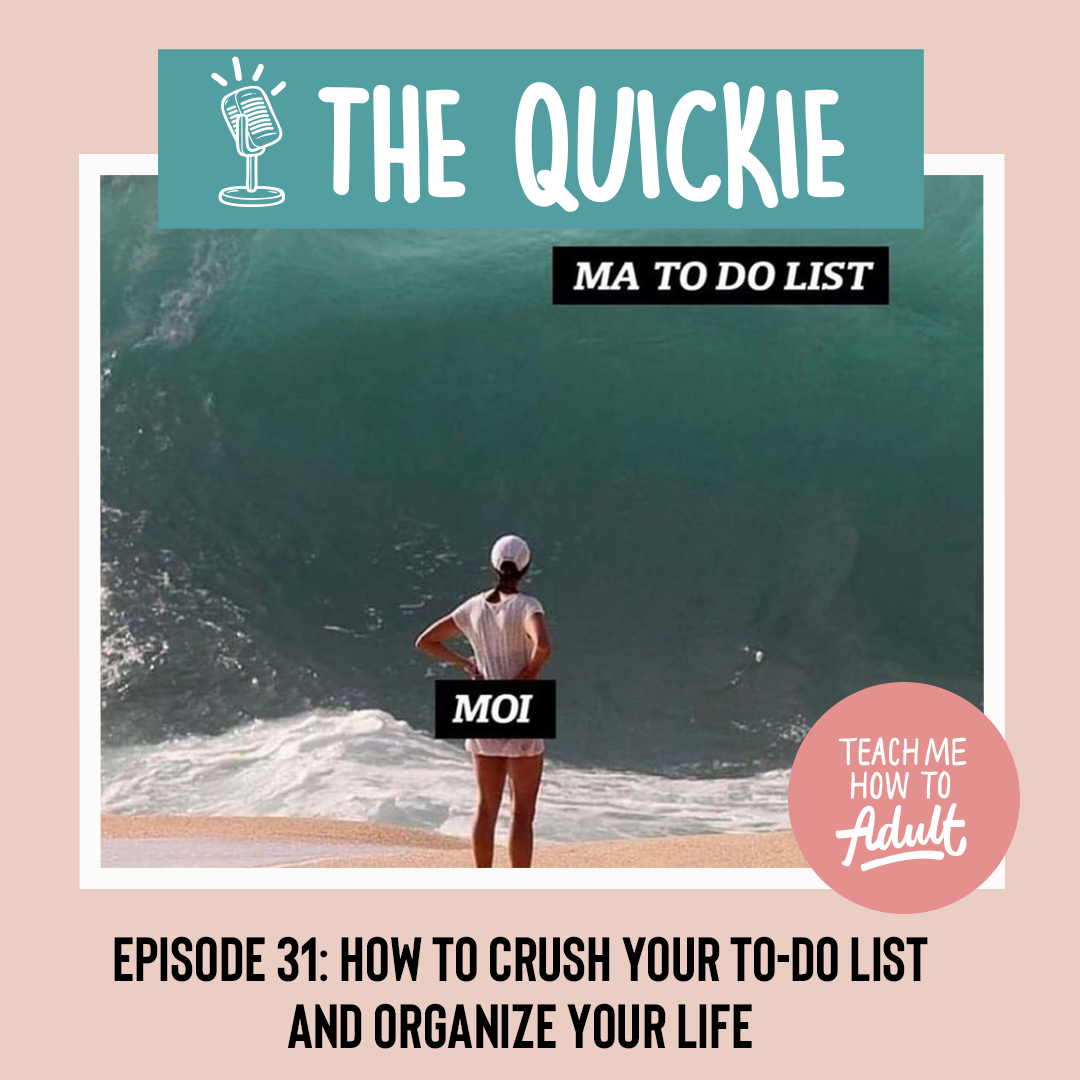
If you, like us, have been struggling to cross literally ANYTHING off of your never-ending to-do lists, we are here to help!
There are so many reasons why tackling your to-do list can cause anxiety and overwhelm. If you’re super burnt out right now you could be feeling errand paralysis, or if you’re insanely busy these days, those lists can feel so daunting because EVERYTHING seems urgent.
So in this week’s quickie, we’re giving you tips on how we structure our days (or at least try to), three of the top to-do list methods that pros swear by, and the tools you can use to help you crush all of your goals and leave you worry-free at the end of the day. It all comes down to prioritization.
Listen along to learn more about:
The Ivy Lee Method
The Eisenhower Matrix
Warren Buffet’s Two List Method
Cailyn’s tips for getting through to-do lists
Gill’s hot 15-minutes-or-less tip
We hope this episode helps you smash your to-do list and accomplish all of the daily tasks and goals you set out for yourself!
If you have a topic you’d like us to cover or a guest you want us to interview, comment or DM us on Instagram:
Related Episodes:
Episode 10: How To Form A Habit - And Stick To It
We’ve all heard these famous sayings, “We are what we repeatedly do” and “excellence is not an act but a habit.” But how do you actually form new ones that stick? In episode 10, we’re diving into how to hack your habits (and actually stick to them).
We’ve all heard these famous sayings, “We are what we repeatedly do” and “excellence is not an act but a habit.” But how do you actually form new ones that stick? In episode 10, we’re diving into how to hack your habits (and actually stick to them).
It only takes 21 days to form a habit, and with all this time spent at home right now, a lot of us have more time and space to work on developing new behaviours we’ve always wanted to tackle. But it can feel really daunting and hard to find the motivation, because we’re all out of our routines, and habits require routine.

But habits don’t need to be these huge, crazy life changes! They actually work best when they’re small, subtle tweaks, and the key to making them stick is routine. It’s turning your habits into automatic processes where you can act without thinking, like brushing your teeth before bed.
The science behind our habits
It helps to understand why habits are at the core of everything we do, and how you can shape and change them to have a positive impact on your life. One of the best books on this topic is The Power of Habit: Why We Do What We Do in Life & Business by Pulitzer-prize winning best-selling author Charles Duhigg. Duhigg explains that habits work in 3-step loops: Cue, Routine & Reward.
The Cue is what triggers you to do a habit, so, setting your alarm to wake you up everyday at 8:00AM. Having a trigger helps create a ritual that you can use to follow through with your habit.
The Routine is the behavior that you then automatically do after the Cue. For example when you first get out of bed you might brush your teeth, wash your face and go make a coffee in the same order every day.
And then the Reward is the part of the loop where you receive something for completing your habit. So that could be the comforting feeling of that first sip of coffee in the morning. Or maybe it’s taking a long hot shower after a tough workout.
So the key to start forming new habits or to changing any bad habits, is to understand your cue, change your routine and, reward yourself in a positive way that will encourage you to want to do that habit again and again.
Shaping your identity with habits
Simple habits have the power to change your self-image, confidence and mindset. That’s why they really matter—they change your internal narrative about yourself. How many times have you told yourself that, “you’re not a morning person, you’re bad at remembering things, you’re just not organized, or you’re always late?” The thing about habits is that when you show up and follow through with them, they help support the ideals of being a certain type of person.
Habits are the evidence that allows you to identify as something: Your immediate goal may be to run a marathon, but it’s ultimately to identify as a “runner”. You might want to start reading a few books on your list, but what you actually want, is to be “a reader”.
You can also think of habits like you think of compound interest, in the sense that the effects of your habits multiply as you repeat them. You might not see a lot of difference day to day, but they can really change your life in a few months or years. They’re like the compound interest of self-improvement!
7 Ways To Hack Your Habits
Whether you’re looking to nail a new morning routine, start meditating, read more, or start working out (check out episode #9 of the podcast, with fitness coach Beverley Cheng, for more workout inspo), we’ve rounded up seven proven strategies for making new habits stick.
1. Commit to 21 days
It only takes 21 days for a habit to stick, and once you’ve established that habit, if you keep up with it for 90 days, it’s guaranteed to become a permanent lifestyle change.
2. Be realistic
It’s way easier to stick to new habits if you start simple. Don’t try to completely change your life in one day, so start small and build from there. If you’re feeling super overwhelmed by a big goal, habit expert James Clear (the author of Atomic Habits: An Easy & Proven Way to Build Good Habits & Break Bad Ones) recommends The Two Minute Rule: Take whatever habit you’re trying to build and scale it down to something that takes just two minutes everyday. So, reading more books becomes reading just one page a day. Working out daily becomes a quick two minute sweat sesh. Then you can build on that scale up once it’s become a habit.
3. Be consistent
Consistency is super important for making a habit stick. Try doing it at the same time, and in the same place when possible for those three weeks. Cues like time of day, place and environment will help make these changes permanent.
A great way to stay consistent is to try Filmmaker and Youtuber Matt D'Avella’s The Two Day Rule: Don’t go 2 days in a row without doing your new habit. That way, if you skip one day you don’t need to beat yourself up over it or give up. Give yourself a one day grace period and you’ll be more likely to stick to your new habit.
4. Try habit stacking
If you’re trying to do a bunch of small tasks regularly, a proven way to get shit done consistently is to group those activities together into a routine, and to link that to a habit you’ve already already set in your day. This anchors your new habits to an existing trigger, and it really does work.
5. Create visual cues
Tangible cues can act as regular reminders to practice your habit. For example, put your running shoes somewhere visible if you want to workout more or put athletic clothes on when you wake up, or leave your book on your night stand if you’re trying to read more.
6. Schedule in your habits
Scheduling whatever it is you’re trying to accomplish will help you treat it as a non-negotiable that you have to work around. Using an app to track your progress or to help set daily reminders is a great app—we recommend the Tally app, which lets you set daily or weekly goals for each habit. You could also use a connected device like Amazon Alexa to set reminders during the day.
7. Track your progress
You can also track your process the good ol’ fashion way with pen and paper, with something that habit hackers call the Seinfeld method, which was coined by—you guessed it!—Jerry Seinfled. When he was training to become a comedian, he knew that the only way to get better was to consistently write and test out new jokes, so he got a giant calendar and a big red magic marker and would mark an “X” every day that he wrote. Eventually you’ll get a big chain of X’s that will keep motivating you to add more.

We’ve created a free downloadable habit tracker to help you get started, so be sure to check it out here and start tracking your progress!
We hope these tips will help motivate you to start forming the new habits you’ve been dreaming of. Hit us up on social and let us know what’s been working for you!
If you have a topic you’d like us to cover or a guest you want us to interview, comment or DM us on Instagram:
Shop this episode:


I’ve been hitting a ceiling with my upper limits lately — in love, business, and life decisions, limiting beliefs and self-sabotage have been showing all the way up. So I revisited this episode with Lori Harder, and it was a powerful reminder of how to get out of my own way… it felt right to throw it back to this top-performing episode today for anyone who needs to hear this.