
Episode 75: Teach Me How To Build Resilience and Master My Mindset, with Leisse Wilcox | Summer Rewind
For the rest of the summer, we’re doing a Summer Rewind, re-releasing some of our must-listen episodes as we ramp up to the launch of season two. See you in September friends!
Change and adversity are the only constant in this life, and if this year has taught us anything, it’s that the more you focus on building a solid foundation within yourself, the more external chaos you can handle.

For the rest of the summer, we’re doing a Summer Rewind, re-releasing some of our must-listen episodes as we ramp up to the launch of season two. See you in September friends!
It feels like change and adversity are the only constant in this life, and if this year has taught us anything, it’s that the more you focus on building a solid foundation within yourself, the more external chaos you can handle.
Shifting our mindsets, perception and reactions is far from easy, but that’s the key to healthily recovering from turmoil and trauma. So, we called in mindset and success coach Leisse Wilcox to teach us everything we need to know about how to cultivate mental resilience and turn whatever life throws at you into a beautiful story.
And Liesse is not just your average coach. She is a coveted mindset coach, podcast host, AND bestselling author, who is changing the global conversation on emotional health & wellness. She literally wrote the book on turning adversity into opportunities for growth, joy and beauty.
Listen to our chat with Liesse to learn more about:
Our tools for bouncing back from adversity
Why your mindset matters
The meaning of emotional alchemy (turning the dark and heavy pieces of your life into something beautiful and light)
Leisse’s 10 steps to cultivating emotional alchemy
How to avoid toxic positivity and *actually* deal with your sh*t
Ways to process and feel your feelings
How to make a difficult life change with grit and grace
The importance of staying in the present moment and “zooming out”
Why gratitude is the key to mindset
We hope this episode helps you center yourself and find grace in these ~unprecedented~ times.
If you have a topic you’d like us to cover or a guest you want us to interview, comment or DM us on Instagram:
Related Episodes:


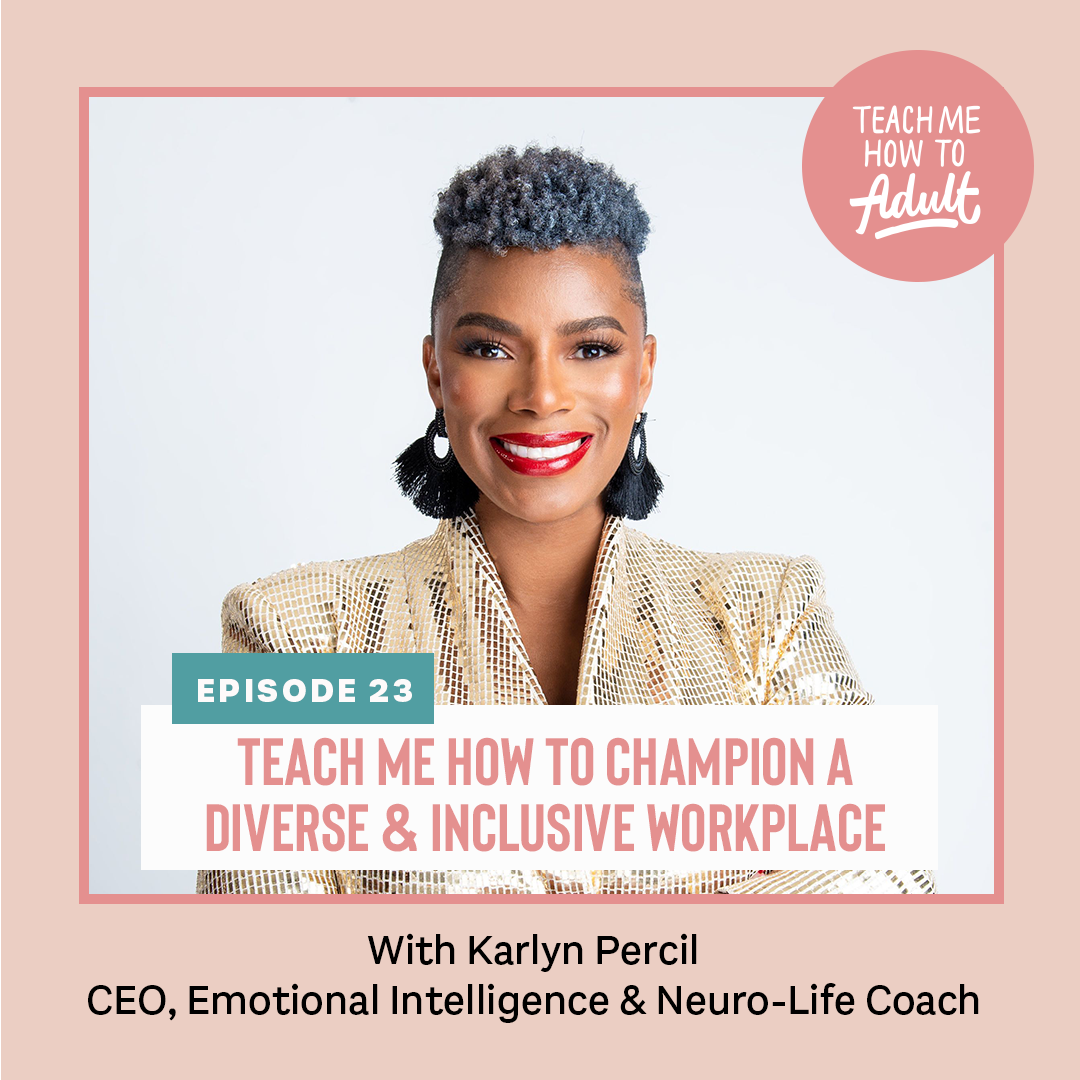
Episode 23: How to Champion a Diverse & Inclusive Workplace
We had the privilege of talking with Karlyn Percil about the racial pandemic we’re still facing, and the state of diversity and equality in the workplace, and what we can do to make businesses more inclusive. Because equitable work is a key to breaking the cycle of oppression, and the right to earn a living in a safe, inclusive workplace is a basic human right.
In this episode, we learned how to use emotional intelligence and positive psychology to help create equal opportunities for BIPOC employees, to shift hiring practices and dated work cultures, and to eliminate harmful microaggressions that prevent employees from feeling safe enough to bring their whole selves to work.
Diversity shouldn’t be a trend, it should be a standard.
We had the privilege of talking with Karlyn Percil about the racial pandemic we’re still facing, and the state of diversity and equality in the workplace, and what we can do to make businesses more inclusive.
Because equitable work is a key to breaking the cycle of oppression, and the right to earn a living in a safe, inclusive workplace is a basic human right.
In this episode, we learned how to use emotional intelligence and positive psychology to help create equal opportunities for BIPOC employees, to shift hiring practices and dated work cultures, and to eliminate harmful microaggressions that prevent employees from feeling safe enough to bring their whole selves to work.
While it is 100% *our* job as white women to educate ourselves on systemic racism and how to be an anti-racist ally, we’re so grateful that Certified Emotional Intelligence and Neuro-Life Coach Karlyn Percil spent time chatting with us about how to leverage bravery, leadership, empathy and vulnerability to create more equitable and safe workplaces for BIPOC communities.
Karlyn has dedicated her career to increasing emotional intelligence in the workforce and helping corporations plan and execute Diversity, Equity and Inclusion strategies. She’s the CEO of KDPM Consulting, the Founder of SisterTalk Group, and she spreads her infectiously positive and empowering mindset tools on talk shows like CityLine, on CBC and in the pages of Forbes and Refinery29.
Listen to our chat with Karlyn to learn more about:
The current state of racial diversity in the workplace: 2:05
Changes you can make right now to promote inclusivity and diversity at work: 3:00
Why corporate “Listening and Learning” sessions are missing the mark, and how to improve them: 15:35
The reality of changing “company culture”: 21:39
What microaggressions sound like and how to take accountability: 22:30
Why you will 100% screw up on your anti-racism journey, and why you should keep going out of your comfort zone: 24:28
Using emotional intelligence to examine defensiveness, shame and fear: 30:16
How to be a better ally through Karlyn’s LEAP strategy: 31:30
The hiring practices that ensure inclusivity and equity: 36:10
How to respond to racial injustice and getting “called in” on social media: 51:08
We hope this episode inspires you to take action in your workplace and further your journey to becoming an ally.
Follow Karlyn:
Get Karlyn’s 2021 Success Planner!
If you have a topic you’d like us to cover or a guest you want us to interview, comment or DM us on Instagram:
Related Episodes:


Episode 21: How to Cultivate Resilience and Master Your Mindset
It seems like pivot and resiliency are the hottest buzzwords of 2020. After all, change and adversity are the only constant in this life, and if this year has taught us anything, it’s that the more you focus on building a solid foundation within yourself, the more external chaos you can handle.
Shifting our mindsets, perception and reactions is far from easy, but that’s the key to healthily recovering from turmoil and trauma. So, we called in mindset and success coach Leisse Wilcox to teach us everything we need to know about how to cultivate mental resilience and turn whatever life throws at you into a beautiful story.

It seems like pivot and resiliency are the hottest buzzwords of 2020. After all, change and adversity are the only constant in this life, and if this year has taught us anything, it’s that the more you focus on building a solid foundation
within yourself, the more external chaos you can handle.
Shifting our mindsets, perception and reactions is far from easy, but that’s the key to healthily recovering from turmoil and trauma. So, we called in mindset and success coach Leisse Wilcox to teach us everything we need to know about how to cultivate mental resilience and turn whatever life throws at you into a beautiful story.
And Leisse is not just your average coach. She is a coveted mindset coach, podcast host, AND bestselling author, who is changing the global conversation on emotional health & wellness. She literally wrote the book on turning adversity into opportunities for growth, joy and beauty.
Listen to our chat with Leisse to learn more about:
👊 Our tools for bouncing back from adversity: 2:08
🙇🏽♀️ Why your mindset matters: 8:50
✨ The meaning of emotional alchemy (turning the dark and heavy pieces of your life into something beautiful and light): 10:37
🔟 Leisse’s 10 steps to cultivating emotional alchemy: 13:11
😬 How to avoid toxic positivity and *actually* deal with your sh*t: 25:46
🤗 Ways to process and feel your feelings: 28:33
💃 How to make a difficult life change with grit and grace: 30:31
💆🏾♀️The importance of staying in the present moment and “zooming out”: 34:27
🙏Why gratitude is the key to mindset: 38:52
We hope this episode helps you harness resilience and a positive perspective to deal with whatever life throws at you.
Follow Leisse:
Get her AMAZING book: To Call Myself Beloved


If you have a topic you’d like us to cover or a guest you want us to interview, comment or DM us on Instagram:
Related Episodes:




Episode 02: How To Gain Confidence and Overcome Impostor Syndrome
Raise your hand if you’ve ever felt like you’re not good enough, or that you don't deserve the job or promotion or opportunity that you’ve earned. That’s Impostor Syndrome talking, and most of us (70% of the population!) have experienced it at some point, in the workplace or our relationships or passions. It's super common among high achievers, creatives and women.

Raise your hand if you’ve ever felt like you’re not good enough, or that you don't deserve the job or promotion or opportunity that you’ve earned. That’s Impostor Syndrome talking, and most of us (70% of the population!) have experienced it at some point, in the workplace or our relationships or passions. It's super common among high achievers, creatives and women.
But fear not! Today we’re talking to the expert, Raia “Coach” Carey, who knows a thing or two about how to stop Impostor Syndrome in its tracks. She’s a 3x certified life coach and motivational speaker who specializes in confidence, visualization, and career coaching, and she gave us some FIRE strategies for gaining confidence and shutting down those doubtful voices in our heads.
What does Impostor Syndrome sound like?
One of the most common signs of Impostor Syndrome is that voice in your head that questions: “Who am I to do this?” It shows up as negative self-talk and doubtful narratives we plant in our minds. “It’s the language we use that reflects our lack of confidence,” says Coach Carey. “It’s like, ‘I don’t have any experience, so no one will ever hire me’.”
According to Coach Carey, Impostor Syndrome shows up in the places and spaces you need to be, “Deep down you know that’s where you need to grow, and it’s going to be uncomfortable. There’s something inside you that knows this is the exact kind of growth and challenge you need. Lean into that.”
The truth is, you don’t have to be perfect to be qualified or capable. That’s just a story we tell ourselves. “We want to be perfect before we inspire,” says Carey, “But it’s the imperfections that actually end up inspiring people.”
Signs that Impostor Syndrome is taking over can include burnout, avoidance, and an ongoing lack of fulfilment for perfectionists. It shows up as employees overworking themselves to compensate for a perceived deficit, taking on way too much to prove that they’re worthy. And it can lead to missed opportunities for people who are hella deserving.
The five types of Impostor Syndrome
Dr. Valerie Young has made a career of studying Impostor Syndrome, and she breaks it down into five different types, which helped us understand where and how Impostor Syndrome can creep up.
The Perfectionists: They have extremely high expectations for themselves, and even when they meet 99% of their goals, they still feel like failures.
The Experts: These folks feel like they need to know allllll the info before they’re willing to start a project, and they won’t apply for a job if they don’t meet every bit of criteria in the description.
The Natural Genius: They’re used to things coming easily to them, and when they have to put in more effort, their brain tells them that’s proof they’re an impostor.
The Soloists: These guys feel like they have to accomplish everything on their own, and that needing help makes them a failure.
The Superwoman/Superman: They push themselves to work harder than those around them to prove they’re not impostors. They need to succeed in all aspects of life, and feel stressed when they’re not the best at something.
If you identify with any of these, Coach Carey recommends trying to reframe these thought processes by questioning and countering them. For example, if you’re a soloist who needs to do everything on your own to feel worthy, challenge that idea by exploring the value of forming a mastermind group where you can gain info from other subject matter experts. You’ll likely end up finding empowerment in collaboration after all.
Strategies for overcoming it
“Everyday remind yourself that no matter where you are in life, you can always get to other places,” says Carey. “You have every single thing you need. You can make any change in your life if you take the time to figure it out.” Consider us inspired AF.
Watch how you talk to yourself. Negative self-talk leeches into your subconscious and your subconscious will focus on the harmful statements that hold the most power, like “I could never get that job,” or “I’ll never be beautiful enough to do that thing.” Your words shape your world, so be careful which ones you use. Write down or say positive affirmations out loud to replace those negative thoughts.
Coach Carey is even careful of how she talks about to-do lists. “To-do lists are a choose list. Every single day you get to choose what you do. We always have a choice.”
It can also help to have a positive mantra or quote to keep you going. Coach Carey’s is: “Embrace where you are today in life, knowing it’s not where you have to stay.”
Unpack yourself. Coach Carey recommends starting with the following four questions every night before bed:
What worked well for me today?
What didn’t work well for me?
What fuelled me?
What drained me?
After two weeks you’ll see patterns of what’s helping or hindering you. It helps to track your goals, momentum and behaviours so you can figure out what you want to change or do more of, so take conscious quality time with yourself to check in with no distractions.
Use visualization. Coach Carey uses visualization a lot to help her clients. Here’s what her approach looks like:
Start with imagining what your ideal life would look like if you could change anything you wanted. Let your imagination wander, picture what your day is like, how you are acting and feeling.
Break that down into three top “goals” or “wants” that you can work towards. These could look like a raise in your job, or living in a different city, or a better health and fitness regime.
From there, come up with action-oriented steps and tools you can implement to make those changes.
Ask yourself who is impacted by these changes you would make. Will your family be happier living in a better city? Will a shorter commute allow you to spend more time with your loved ones? This will help form your “why” that will motivate your goal.
Remember, the key to effective visualization is removing the barriers and mental blocks, and creating a safe space to imagine what your life could be like. Because everything you can imagine is possible. So imagine, then come up with the strategies and tools to implement.
Fight fiction with fact. When you’re feeling not good enough for something, make a list of all the things that prove you're just as qualified as anyone else. Get specific and include tangible results that support your value. And keep track of your wins! We naturally hold onto all the times we felt that we failed, but we should be focusing on the times we succeeded. Keep a document or Inbox folder of any praise, kudos and positive feedback that can remind you of your value.
Engage with your hobbies: Do the things that make you feel at your best, says Coach Carey. If you consistently show up feeling your best, you’re more likely to succeed in other areas of your life.
“We live in a time where we did all of our hobbies as kids, and then bills, work, school and society got us to stop,” explains Coach Carey. “But those are the things that truly bring us joy. And joy and happiness are different. Happiness you can find in almost everything, but joy you can only give to yourself.”
Dealing with Impostor Syndrome in your career
Impostor Syndrome can get in the way of pursuing promotions, new gigs and higher salaries or freelance rates. While most people focus on perfectionism and having all the experience before they pursue opportunities, Coach Carey says it’s not always about being the most experienced. “People are way more willing to follow a leader than a boss.”
“Vulnerability makes you way more relatable as a leader. We’re all learning, and people are way more willing to learn with you. Humility is what resonates,” she says.
And what if you don’t have all the answers or expertise in a job interview? Coach Carey suggests approaching an interview by saying: “That’s one area I’m not fully well-versed in, but I’m happy, motivated and willing to learn. I’ve already signed up for a course [to fill that knowledge gap]. If you already recognize the problem and come with solutions, I’d give you the job over the perfectionist.”
And when it comes to gaining the confidence to negotiate your pay, Coach Carey recommends figuring out what number you’d be really happy with, then adding onto that. Even if you just add $500-$1000. And if you get paid that much, the next time you can try adding more. Because you’ll deserve it.

















I’ve been hitting a ceiling with my upper limits lately — in love, business, and life decisions, limiting beliefs and self-sabotage have been showing all the way up. So I revisited this episode with Lori Harder, and it was a powerful reminder of how to get out of my own way… it felt right to throw it back to this top-performing episode today for anyone who needs to hear this.